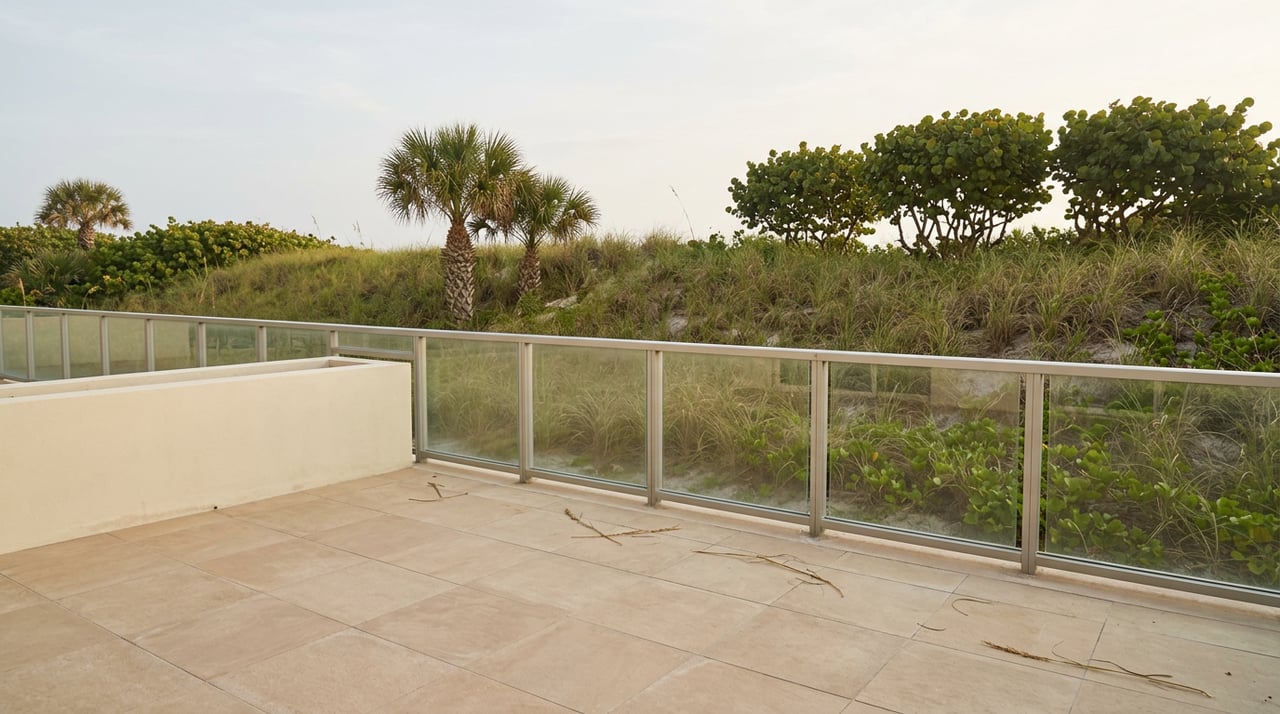
Lido Key's Beach Is Finished. The Guarantee Behind It Isn't.
September 17, 2026
September 17, 2026
Ask a Lido Key condo owner which beach fronts their building, and most will just say "Lido Beach." That answer is close enough for a dinner party and not specific enough for a purchase contract, because Lido Key actually has three named beaches under one casual label: North Lido Beach, the main beach at the Lido Beach Pavilion, and Ted Sperling Park at South Lido Beach. This spring the city finished a $12 million renourishment project on part of that shoreline, and a follow-up dune project is set to break ground on the same stretch this week. If you're comparing Gulf-front listings on Lido Key right now, whether that protection actually applies to the address you're touring depends on which of those three beaches it sits on, and on a stack of paperwork that never shows up on a listing sheet.
The renourishment that wrapped with a ribbon-cutting in late May 2026 restored about 1.2 miles of shoreline, using roughly 300,000 cubic yards of sand dredged from New Pass, the channel separating Lido Key from Longboat Key. That work ran from the area near the pavilion south toward Ted Sperling Park, not the length of the island. The dune-restoration phase, with equipment scheduled to arrive this week, follows the identical footprint, from the pavilion south to, but not including, Ted Sperling Park, where crews will raise dune height by two feet to reach an elevation of 6.6 feet and move the shoreline's storm protection from what the city calls a 10-year event standard to a 25-year one.
City Engineer Nikesh Patel described what prompted the work before construction began:
"It's to the point where you can see some of the seawalls on the properties due to the erosion."
Sections of shoreline had lost between 50 and 100 feet of sand since the last renourishment cycle in 2021, with some stretches showing degradation the county put at up to 90 feet by the time the renourishment began in January 2026.
North Lido Beach, the stretch running north from the pavilion toward New Pass, sits outside this year's project footprint. That doesn't mean it's neglected or at greater risk. It means the specific $12 million in federal money and the specific dune work funded this year applied to a defined southern segment. A buyer touring a unit near North Lido Beach is looking at a different maintenance and funding history than a buyer touring a unit closer to the pavilion or Ted Sperling Park, even if both listings say "Gulf-front."
Beach renourishment sounds like a public works project that happens because a beach needs it. In practice, none of it moves without signed easements.
Before the Army Corps of Engineers can build on private beachfront, it needs real estate certification, meaning someone with legal authority over the land has to grant access. In May 2025 the Sarasota City Commission approved a temporary access easement and assigned 21 Perpetual Beach Storm Damage Reduction Easements to Sarasota County. The County Commission formally accepted them on June 3, 2025. Those 21 signatures are what allowed the Corps to proceed under the city's 50-year partnership agreement, which calls for renourishment roughly every five years: the last full cycle ran in 2021, this one in 2026, the next expected around 2031.
That sequence isn't automatic everywhere on Florida's coast. In Pinellas County, similar renourishment work for Treasure Island and St. Pete Beach has stalled for years over unresolved perpetual easements, with the Army Corps declining to move forward until property owners sign. Erosion doesn't trigger federal funding. Signed paperwork does.
For a Lido Key buyer, this means the "next renourishment" isn't a law of nature. It's a commitment tied to a specific set of easements on a specific stretch of shoreline, renewed through a federal appropriations process the city's lobbying firm, Color Nine Group, has worked in coordination with Representative Greg Steube's and Senator Rick Scott's offices to keep funded. Even the people closest to the project are treating the next cycle as an expectation rather than a guarantee. Carl Shoffstall, president of the Lido Key Homeowners Association, put it plainly at the ribbon-cutting:
"We are looking for the next one already."
| Renourishment | Dune Restoration | |
|---|---|---|
| Cost | $12 million | About $1.2 million, including roughly $700,000 in construction |
| Funding source | Federal disaster relief through the Army Corps: $8 million in 2022, $4 million more in 2025 | Local tourist development tax revenue and state environmental grants |
| Footprint | Pavilion south toward Ted Sperling Park, 1.2 miles | Same stretch, pavilion south to (not including) Ted Sperling Park |
| Standard | Restored to roughly pre-storm width | Raises dune height to 6.6 feet, moving from a 10-year to a 25-year storm protection standard |
| Timeline | January through late May 2026 | Begins this week, continuing into early 2027 |
Here is where the mechanism actually touches a purchase decision. Lido Key's condo stock splits cleanly into two eras. The pre-2000 Ben Franklin Drive cohort includes buildings like Lido Ambassador, built in 1978, Lido Beach Club, from 1974, and Lido Harbour South, from 1968, all offering Gulf-front access at a more accessible price point than the island's newer towers. The post-2000 cohort includes the Ritz-Carlton-managed Beach Residences and the under-construction Rosewood Residences. Key Tower South sits in between, with smaller, efficient floor plans that keep carrying costs lower than the newer luxury buildings around it.
Pricing data on Lido Key swings by source and by month depending on which slice of that inventory happens to be active. Portal-reported figures put the median condo price around $1.65 million in August 2026, with average sale prices above $2 million. A few weeks later, active MLS listing data put the median asking price for a Lido Key condo closer to $775,000, reflecting a mix that leaned toward smaller, older units that particular week. Neither number is wrong. They're measuring different slices of the same small island, which is exactly why a single median tells a buyer less than the age, cohort, and shoreline segment of the specific building they're standing in front of.
The renourishment and dune work add one more variable to that comparison. A unit inside this year's project footprint inherits both the widened beach and the easement history that keeps future cycles funded. A unit on North Lido Beach inherits a different maintenance timeline, regardless of what the listing calls it.
A few questions are worth asking no matter the price point or building age:
None of these show up on a listing sheet. They show up in the easement filings, the city's project maps, and the conversation you have before writing an offer, not after.
If you're comparing Gulf-front listings on Lido Key this fall, the beach itself is only part of the story. The paperwork behind it is the rest. Chris Carpenter has spent more than two decades working Sarasota's barrier islands and can walk you through which segment of shoreline a specific address actually sits on before you ever tour it. Let's Connect.
How Serious Buyers Read Sarasota Waterfront Homes From the First Step Inside.
Why Life Here Feels Bigger Than the Four Walls of a Home.
Where Coastal Living Meets Smarter, Greener Building.
Whether you're looking to purchase your first home, a forever home, or that investment or commercial property, Chris would be honored to have the opportunity and partner with you on the journey.