The $620 Question Every Longboat Key Canal Buyer Should Ask Before Closing
September 10, 2026
September 10, 2026
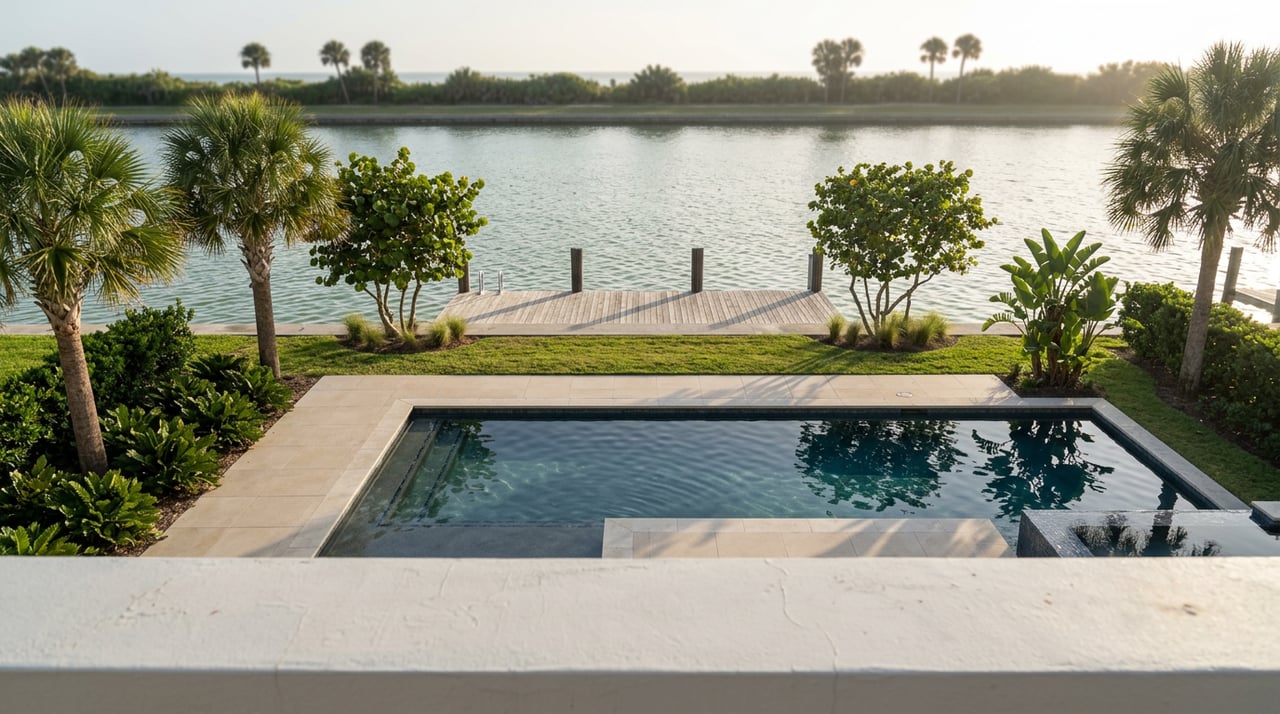
As Your Observer reported, when Jay and Lynne Plager went looking for a home on Longboat Key, the pitch that sold them was simple: step off the back porch, drop the boat in the water, and go. Plager had wanted a canal and a boat since he was 13, and Country Club Shores gave him both, along with room for a 29-foot trawler he named Scarlet Lady. The canal itself hadn't been dredged since 2003. By the time the Plagers were living the fantasy, the water under their boat lift had grown so shallow that the hull caught at low tide. They fixed their own stretch with a bow-shaped lift and a rebuilt bulkhead. The town is now addressing the rest of it through a proposed canal assessment, which could add a cost for canal-front owners.
According to LBK News, Longboat Key's Town Commission gave unanimous first-reading approval this spring to a roughly $9 million program to dredge all 88 of the island's canals, the first comprehensive maintenance the waterways have seen in more than two decades. A second and final reading was the last procedural step standing between the plan and enactment, and if it holds, as every signal from the town's own budget planning suggests it will, the first assessments will appear on canal-front owners' property tax bills this November. That timing matters for anyone buying, selling, or comparing canal-front property on Longboat Key right now. Until the first bill is issued, however, the proposed assessment will not appear in current tax records.
The idea of a formal canal maintenance program isn't new on Longboat Key. Conversations date back to the 1990s, and Public Works Director Charlie Mopps has counted more than thirty commission meetings on the subject since 2013. What changed in 2026 wasn't the need, it was the accumulation. Twenty-three years of undisturbed sediment had turned a navigation amenity into a navigation problem, and Mopps put it plainly to residents at a town hall: the can had been kicked down the road so many times the road had gone flat. The plan uses a funding structure Longboat Key residents already recognize, one they've been paying into for years.
The canal program uses a cost-sharing formula similar to beach renourishment: roughly an 80/20 split between the people with direct access to the amenity and everyone else on the island. For canals, the flat $620 fee does most of the heavy lifting on its own, raising about 70 percent of the program's revenue. The balance comes from a single ad-valorem millage, 0.0623 mills for the first five years and dropping to 0.032 mills once the initial dredging phase ends, applied to every property on the island. Because canal-facing parcels also pay a share of that same millage, their combined contribution lands around 80 percent of the total, while everyone else's share of the same millage covers the remaining 20 percent.
| Who pays | Mechanism | Share of program cost |
|---|---|---|
| Canal-facing parcels | Flat annual fee (EBU) | About 70 percent |
| Canal-facing parcels | Their share of the island-wide millage | About 10 percent |
| Every other property on the island | Their share of the same island-wide millage | About 20 percent |
Not every resident sees the split as fair. At a public meeting, Trish McDonald, who owns a condo without canal access, raised this question, as Your Observer reported:
"As a practical matter, I, as a non-canal-homeowner, can only access those canals by boat. I don't have a boat, but if I did, my access to those canals is very limited. Is it fair for me to have to assume 20% of the cost?"
As Your Observer reported, Jay Plager sees it differently, comparing the canals to the island's other shared amenity. His view is that the canals are more egalitarian than the beach, since stretches of Longboat Key's shoreline sit in front of condos with no public parking and limited resident access, while the canal network at least touches every corner of the island through the Intracoastal.
The 80/20 canal formula mirrors a structure residents have lived under for beach renourishment for years. That history is worth studying before assuming $620 is a ceiling rather than a floor.
Longboat Key's beach renourishment program leans heavily on outside money that doesn't always show up on schedule. The town's 2028 renourishment, an 800,000-cubic-yard project expected to cost more than $32 million, depends on FEMA reimbursement, state storm funds, and tourist development tax revenue collected from short-term rentals. Earlier this year, the town said it had only "low to mid" confidence it would receive $10.6 million in state storm funds, meaning its own share of the project could land anywhere between $5.2 million and $12.8 million depending on how that grant shakes out. Tourist tax collections, even after a voter-approved rate increase, are only expected to cover a fraction of the total cost. When the outside money falls short, the gap gets filled by the town's own reserves, debt, and property tax levies, which is exactly the same toolkit now backing the canal program.
That pattern is the real reason the canal assessment deserves more attention than its modest starting number suggests. A funding model that regularly needs backfilling on the beach side is now the same model financing the canals.
Longboat Key officials have pointed to Charlotte County's experience after Hurricane Ian as evidence that outside reimbursement works: roughly 95 percent of Punta Gorda's seawall repair costs there were ultimately covered by FEMA and the state. The more useful lesson for Longboat Key buyers isn't about whether reimbursement arrives. It's about what happens to the assessment once a maintenance district is up and running. In Punta Gorda, the comparable post-storm assessment has moved in only one direction since it began. The town's plan to cut the island-wide millage roughly in half after five years is the current commitment, but it is a projection, not a guarantee written into the concrete.
If you're evaluating a canal-front home on Longboat Key this fall, or getting one ready to list, a few direct questions will tell you more than any listing sheet currently can:
Does the island-wide millage apply to condo owners on Longboat Key? The island-wide millage applies to every property.
Will the rate really drop after five years? The town's plan calls for the island-wide millage to fall from 0.0623 to 0.032 mills once the initial dredging work wraps and the program shifts to ongoing maintenance. That's the stated plan. Whether it holds is worth watching, given that a comparable assessment in Punta Gorda has only increased since it started.
What if I'm already under contract? Ask your title company or the seller directly whether this parcel has been assessed for the current tax year or whether the charge begins with the November 2026 bill.
Canal access has always been part of what makes Longboat Key's waterfront market what it is. Knowing exactly what that access costs, before the assessment appears on a property tax bill, is the kind of detail that separates a smooth closing from a renegotiation. If you're weighing a canal-front purchase or getting one ready to sell on Longboat Key, Chris Carpenter can walk through the parcel-specific numbers with you before you write or accept an offer. Let's Connect.
This article is general information, not legal, tax or financial advice. Consult a qualified professional about your situation.

Where in Sarasota to Find Gourmet Restaurants.

A Golden-Hour Sarasota Sunset Experience on the Bay, From Dinner Boats to Quiet Sails.

Four Ways to Spend an Evening Well in This City.

How a Coastal Color Palette Brings Gulf-Inspired Calm to Sarasota Homes.
Whether you're looking to purchase your first home, a forever home, or that investment or commercial property, Chris would be honored to have the opportunity and partner with you on the journey.